Purchasing, run by an AI.
The front page shows what Synapsio does for you. This page shows how: which figures go in, which method does the calculating, where the AI decides and where you do.
Every order the agent places opens up like this: the method it chose, the figures behind it, the limits it checked and the sentence explaining why this became an order.
Five steps that never stop
An agent you have to trigger is a tool. Synapsio keeps going when nobody is watching: read, calculate, decide, act, record. Every lap feeds the next one.
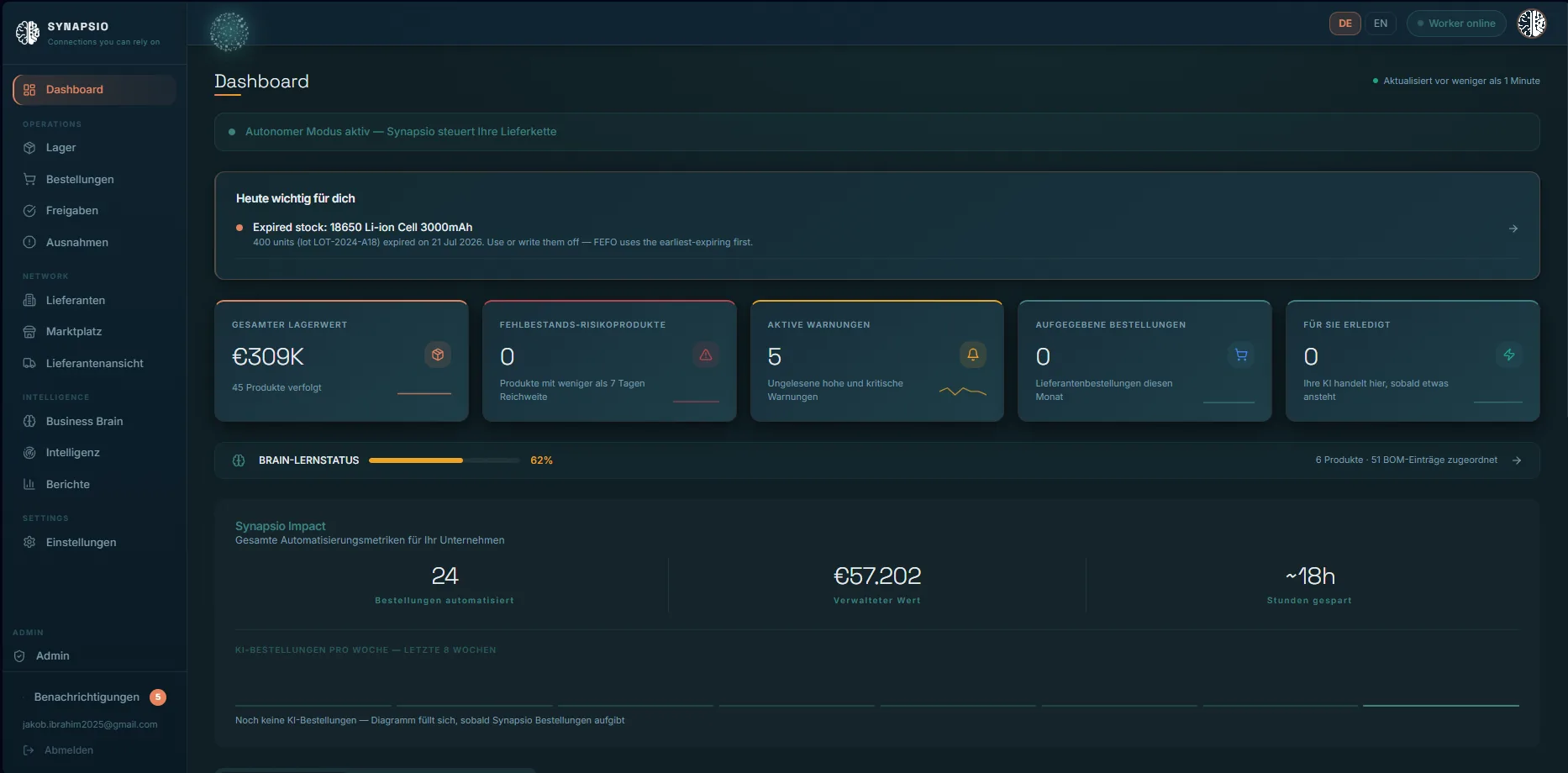
The loop runs on a schedule, not on a button. The agent calculates the demand forecast and looks for anomalies in consumption daily, scans the market several times a day, and works out seasonal patterns once a week. In between it keeps scoring whether its own earlier decisions were right. You start none of it by hand.
Every lap is the same five steps. It reads what comes in: supplier email, order confirmations, goods receipts, production runs, everything that moves stock. From that it calculates days of cover per item, the forecast, the season and supplier risk. It decides which method applies, what quantity is needed and which supplier should deliver, then checks the result against all of your limits. It acts, raises the order, sends the email and the PDF and chases the date. And it records, with a timestamp and a reason.
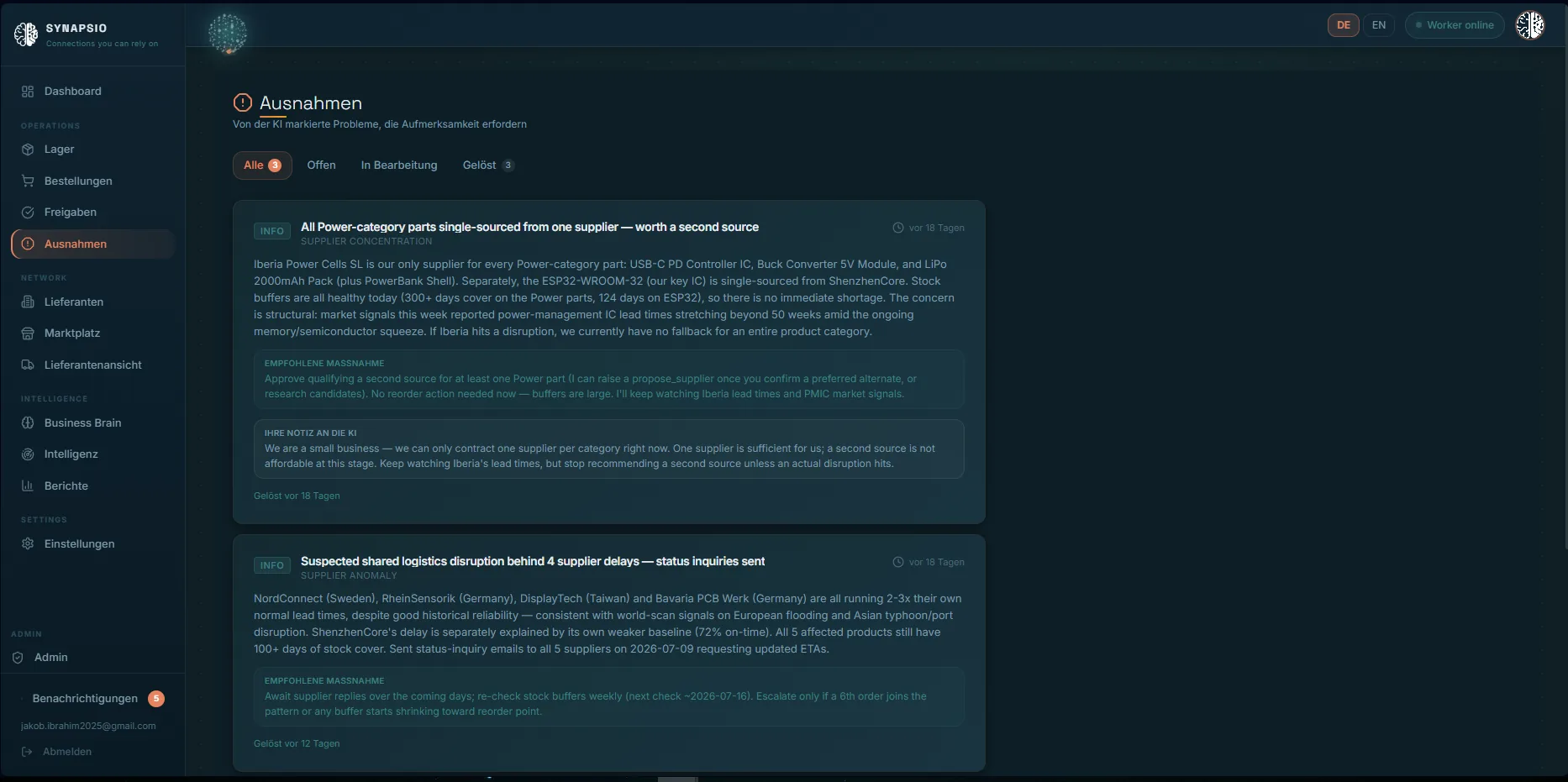
Anything it cannot close cleanly does not disappear. It moves into a separate list as an exception, together with a suggestion for what to do. An order that stalls, a reply that does not match the order, a quantity that is wrong at goods-in: none of it is quietly skipped.
You start none of it by hand. That is the difference between a tool and an operation.
The loop
- 01Read
- 02Calculate
- 03Decide
- 04Act
- 05Record
Where the AI actually decides
The difference is not that something happens automatically. It is who decides which rule does the calculating. In most systems that is a person, once, the same for every item.
That one rule then covers screws and gaskets alike. A minimum level, maintained by hand, that changes when somebody remembers to change it. There is no record of why that particular number is the one sitting there.
Synapsio AI picks the method per item, not just the number. An item with steady consumption needs a different calculation from one pulled three times a year. So each item gets one of five methods: reorder point (s,Q) for steady consumption, Croston for intermittent demand, Newsvendor for perishable goods, periodic review (R,S) for fixed ordering rhythms, and a multi-location calculation when the same item sits in several warehouses.
With the method it also sets that method's parameters. Lead time, safety stock, service level and review interval sit on the item and are adjusted as consumption changes. If you want a method fixed in place, lock it and the AI will leave it alone.
And it writes down why. The item carries which method applies, since when, what the choice rested on and how confident the AI was about it. You can read that without knowing the calculation behind it, and you can disagree with it.
A number can be set. A method has to be argued for.
It reads what comes in
A supplier email is not a form. Every supplier writes differently, and almost none of them write the way an import filter would need. That is exactly why an AI reads this, not a parser.

It always reads against its own order. The reply is matched to the order the agent wrote itself. Quantity, price and date are pulled out, and a confirmed delivery date lands on the order.
If the reply differs, it is not silently accepted. When a supplier confirms a different quantity or a later date, that becomes an exception with both figures side by side. The same at goods-in: receipts are booked against the order, partial quantities are allowed, and anything that does not line up lands visibly on the table instead of in a quiet correction.
Consumption does not come from the stock level, it comes from the bill of material. The agent knows which item sits in which product, and live production runs draw stock down accordingly. Stock itself is kept down to location, bin and lot, not as one number per item.
That is why the agent sees consumption before the stock level shows it.
Supplier emailread
- Item
- Qty
- Date
- Price
Days of cover, not gut feel
A minimum stock level is a number somebody set once. Cover is a calculation that changes every day: how long the stock lasts at current consumption, against the time the supplier needs.
The calculation behind it is not an estimate. Stock divided by average daily consumption, measured against the lead time the supplier actually keeps. The reorder point falls out of that calculation instead of sitting fixed in the item master: daily consumption times lead time, plus a safety stock derived from your service level and the variability of demand.
When consumption changes, the point moves with it. Nobody has to maintain a list to keep the number current. The order quantity then comes from the item's method and from the volume prices held against the supplier.
Stock is not one number per item. Multiple locations, their own storage bins and batches are represented, and the calculation runs per location. Where demand comes from production, the agent derives it from the bills of material and the production runs that actually happened, rather than estimating it.
Alongside that the agent keeps calculating. It produces a demand forecast per item, recognises patterns that repeat across the year, and reports outliers in consumption rather than averaging them in. Delivery reliability and responsiveness produce a risk score per supplier, which in turn feeds into how quotes are compared.
An outlier should not bend the forecast, so it is reported rather than absorbed.
Signals
- Consumption
- Cover
- Reliability
It orders without being asked
Placing the order is the step software usually leaves to a person. A suggestion appears, somebody reads it, somebody clicks. Here the AI carries the job through itself, and you only see what sits above your limit.
It picks the supplier rather than taking the first one. For the same requirement it compares the suppliers on file with their price breaks, their lead time and how reliably they have hit dates before, and writes down why this one won. Price does not decide alone: a supplier who delivers two days after the shortage is not a cheap supplier.
It consolidates rather than trickling orders out. Open requirements for the same supplier are pulled into one order and held until your cut-off, so five separate orders do not go to the same address. Whatever comes up after that goes the next day.
It carries the order through. It raises the order with every line, sends the email and the PDF, matches the supplier's reply to its own order and follows up the confirmed date. Goods-in is booked against the order, part deliveries included.
It scores your suppliers continuously. Delivery reliability, how they answer and the gaps between what was ordered and what arrived become a risk figure per supplier. It does not sit in a report; it flows back into the next comparison.
And it notices when an item is being discontinued. It checks whether a part has been withdrawn or superseded, records the replacement on the item and flags it while there is still time to switch. An item that no longer exists otherwise shows up when the order stops going through.
That is the difference between a suggestion and an order.
Reason
- Steel Precision · €4,120 · 12 days
- Nordschraube AG · €3,980 · 6 days
- Dichttech GmbH · €3,850 · 21 days
Not the cheapest, but the only one before the shortage.
Limits that actually hold
Autonomy without a limit is a promise nobody can keep. So the agent checks every order against all of your limits and stops the moment one is breached. Stopping is the normal case, not the failure case.
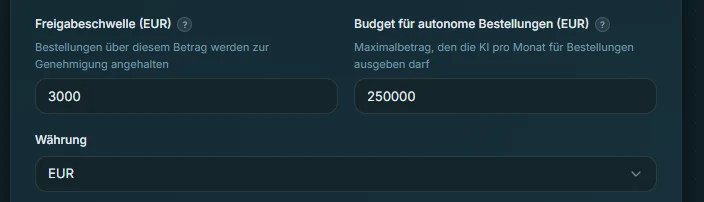
You set four things, and they apply from the next order. The approval threshold is the amount above which an order comes to you: below it the agent places the order, above it the agent puts it up. The autonomy level decides whether it may act at all or only suggest, and switches without a restart. Spend caps apply per order and per day, independently of each other; at the daily cap it stops and tells you. And after the order cut-off nothing goes out, with the rest following the next day.
Who may do what is set per person. Approving, ordering and viewing are separate rights, changeable at any time. Anything that did not run cleanly does not get lost among the orders but sits in its own list with a suggested fix, and you can tell the agent right there what it misread.
When a limit is breached the order is not cancelled. It is put to you, with the calculation beside it.
Approval threshold
It scores its own decisions
Automation repeats itself. Learning means the next lap comes out differently. So every decision here is a record the AI later holds against what actually happened.
Every ordering decision is stored, not just executed. With the method it chose, the signals it leaned on, the quantity it worked out, the reorder point, the deviation from the baseline and a note on whether one of your limits was touched. That is the record that gets scored later.
Later it goes back and checks whether it was right. The same decision is held against what actually happened and given an outcome. A bad call stays visible on the decision instead of disappearing into an average.
If none of the five methods fits, it writes one. The new method gets a name, triggers that say when it applies, and a version. After that it is measured on its outcome like any other, and it disappears again if it earns nothing.
It tests its own market signals against reality too. What it picks up outside does not become a basis unchecked. Signals are tested backwards against what actually happened before they carry weight.
You keep the last word. A method you pin is left alone, and what you approve or reject is itself a signal.
A decision that is never scored afterwards is a rule with better marketing.
Supplier risk, calculated continuously
| Nordschraube AG | low | 24% |
| Steel Precision | medium | 58% |
| Dichttech GmbH | raised | 81% |
It remembers what you decide
Every approval and every rejection is a signal. The agent does not just record what it did. It scores later whether that was right, and draws the next decision from it.
You ask in plain language. "Why this order?" is answered from any page, with the cover, the quotes it checked and the threshold check. You do not have to know where anything is stored to ask about it, and you do not have to be able to follow the calculation yourself.
Reading, comparing, ordering, booking: every step sits in the log with a timestamp, alongside analyses of stock, orders and suppliers without the detour through Excel. When somebody asks in three months why that quantity went to that supplier, it is a query rather than a reconstruction.
Traceable means checkable, not merely retrievable.
It speaks before you ask
A text box would be a chat window. This assistant opens with what currently matters, connects things that sit apart, and answers everything else in your own words.
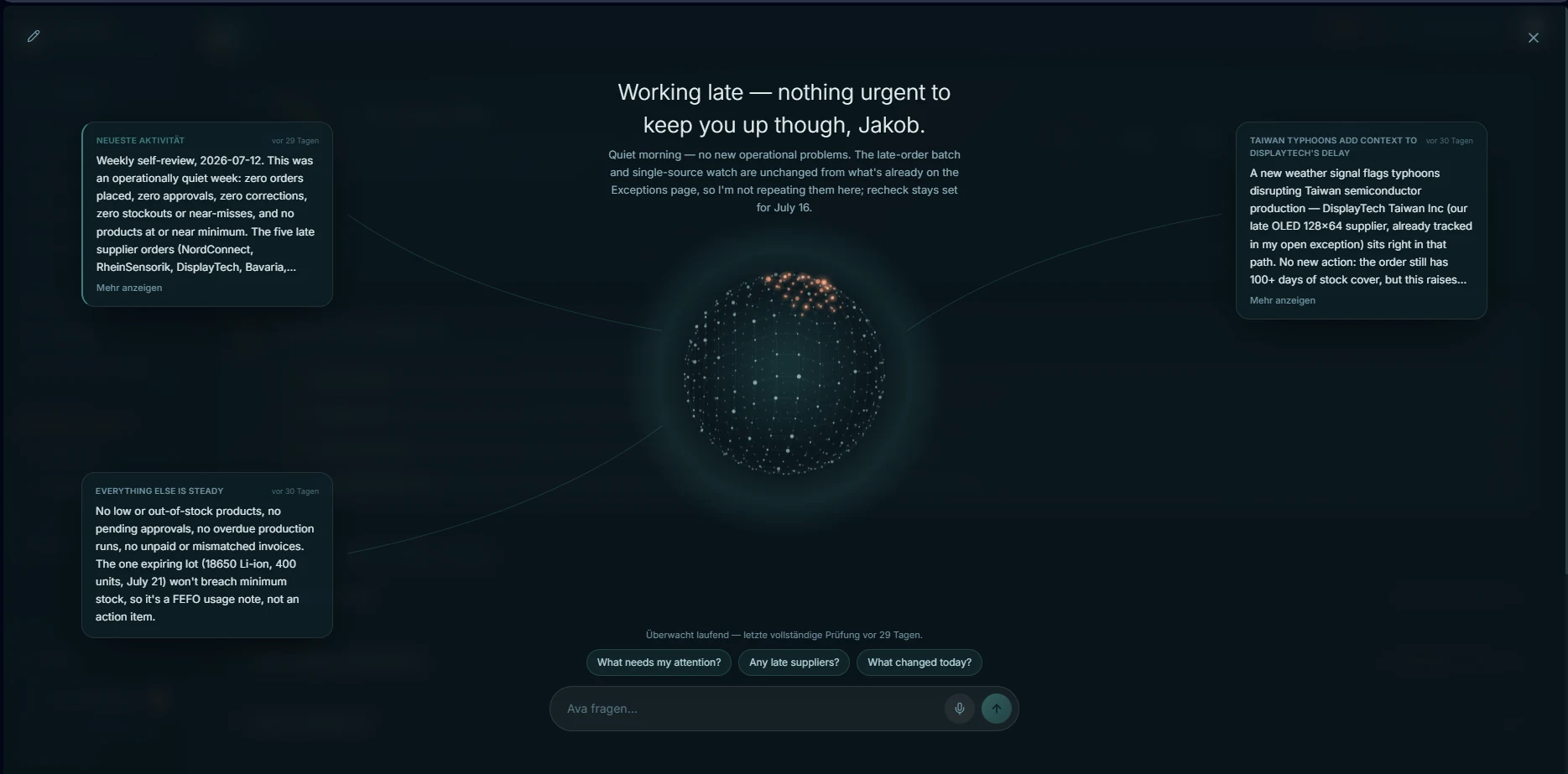
It does not wait for a question. When it opens, it states what has changed since you last looked, and equally what is not urgent right now. It connects what sits in separate lists: a weather signal from market monitoring next to the delivery delay already open as an exception.
It sees what you are looking at. The question carries the context of the page you have open, so you do not have to name the item again. What comes back is drawn from your stock, orders and suppliers, not from general knowledge.
It can act, not only answer. Whatever it did is listed under the answer and linked, so you can check it. The same limits apply as for the agent: above your threshold it triggers nothing without you.
Speak instead of typing. Questions can be dictated, and the answer can be read aloud. On the shop floor that is usually faster than a keyboard.
For the shelf there is the camera. A photo of the bin, a note with it, done. The record lands in the system without anyone walking back to a computer.
It replaces no page. It steps in front when you call it, and steps away again.
What it takes on
- Questions in your own words
- The answer with the figures behind it
- Acting, within your limits
- Dictate, and have it read back
- A photo of the shelf instead of a note
What else you are going to ask
If the agent gets it wrong, you find out in the same place as everything else. Every order is checked against your limits before it goes out, and it stops the moment one is breached. What goes wrong afterwards, because a supplier answers differently or a delivery does not match the order, lands as an exception in its own list, together with a proposal for what to do. Every order also carries its whole decision path: which method, which figures, which supplier and why. That is what you argue from when you call the supplier.
The agent does not start at full autonomy. Out of the box every order waits for your approval. You decide when, and up to what amount, it may act without asking, and you can tighten that again at any time. What you change applies from the next order.
And Synapsio is not an add-on to your ERP. It is the system for purchasing, and it runs even if you have nothing else. If you do have something, it connects: Shopify directly, an ERP by key or credentials, your own systems over webhooks, goods receipt by barcode scan and supplier traffic over email.
What runs, and what does not yet
The same split as on the front page. Anything listed here as "in progress" is not something you can use today.
Live. Everything this page describes runs today. The loop works in the background, the AI reads supplier email and writes orders, it picks the method per item, compares suppliers, consolidates open requirements, scores its own decisions afterwards and flags discontinued items. It calculates cover, forecast and anomalies. Your limits hold, approvals and exceptions come to you, the log is there, and multiple sites, bins and batches are covered.
In progress. Two things you cannot use yet: sales with goods issue, and invoice checking line by line. Both are started and both are still missing.
Vision. And two we believe in but do not promise: a marketplace between companies, and the point where one agent negotiates with another.
If that sounds plausible, let us talk about it.
You have now read how the calculation works, who decides and where the agent stops. The next step is a conversation, not a project: thirty minutes going through your purchasing, with you asking whatever this page does not answer. Nothing to prepare, no data to bring, and no commitment afterwards.